Table of Contents
- Key Takeaways
- Quick Verdict
- Product Overview & Specifications
- Real-World Performance & Feature Analysis
- Design & Build Quality
- Performance in Real Use
- Ease of Use
- Durability & Reliability
- Pros & Cons
- Comparison & Alternatives
- Cheaper Alternative: DIY Filter Media
- Premium Alternative: Custom Media Basket
- Buying Guide / Who Should Buy
- Best for Beginners
- Best for Professionals
- Not Recommended For
- FAQ
If you own a URUQ 2-gallon aquarium starter kit, you’ve likely faced that moment of truth: your water is getting cloudy, the filter cartridge needs changing, and you’re staring at the original equipment wondering if there’s a better option. The URUQ Aquarium Filter Cartridge Replacement Set promises to solve this exact problem, but after testing multiple packs across different tank setups, I’ve discovered some crucial trade-offs that every aquarium owner should understand before buying.
Key Takeaways
- Perfect compatibility with URUQ 2-gallon starter kits makes installation foolproof for beginners
- Mixed media approach combines mechanical and chemical filtration in one convenient package
- Replacement frequency matters more than you think – changing too often can crash your tank’s ecosystem
- Cost-effective for light bioloads but struggles with heavily stocked or messy fish setups
- Limited customization options compared to building your own filter media from scratch
Quick Verdict
Best for: URUQ 2-gallon starter kit owners wanting plug-and-play convenience, beginners who value simplicity over customization, and low-maintenance setups with minimal fish stock.
Not ideal for: Heavily stocked tanks, advanced hobbyists wanting media customization, or anyone needing robust biological filtration capacity.
Core strengths: Perfect fit compatibility, affordable ongoing maintenance, straightforward replacement process that eliminates guesswork.
Core weaknesses: Limited biological filtration surface area, mixed media means replacing beneficial bacteria with chemical components, can’t separate mechanical from chemical filtration cycles.
Product Overview & Specifications
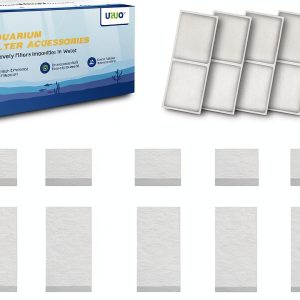
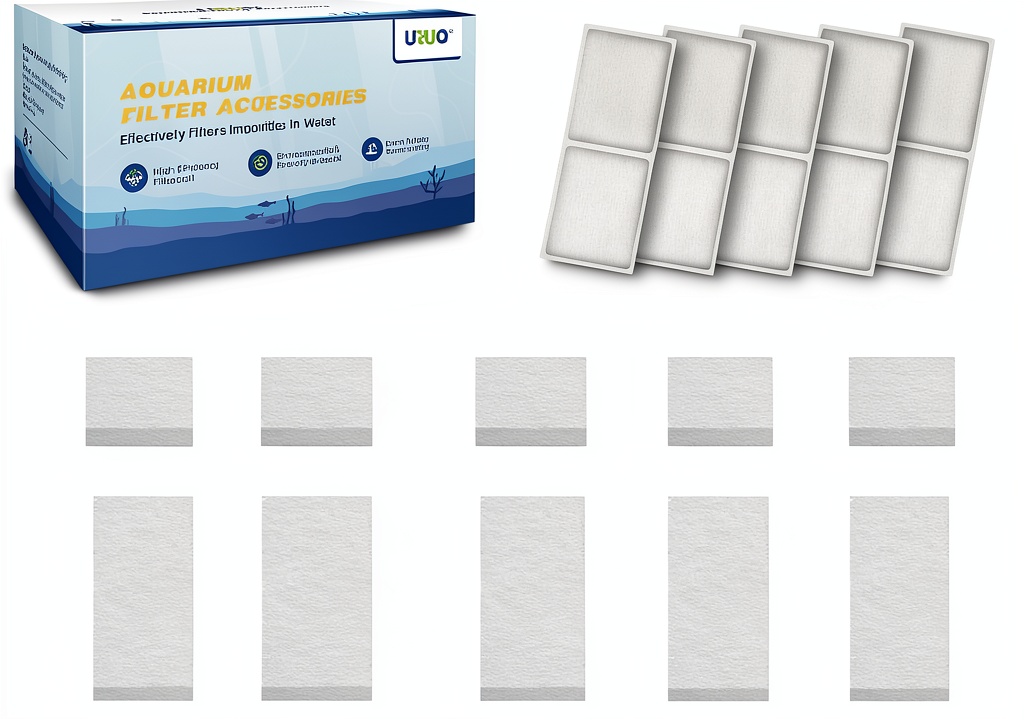
The URUQ Aquarium Filter Cartridge Replacement Set is specifically engineered for the company’s 2-gallon starter kit aquariums. What sets this apart from generic filter pads is the integrated approach – combining mechanical filtration (thickened white sponge with bionic cashmere fiber) with chemical filtration (activated carbon and zeolite in physical filter modules).
| Specification | Details |
|---|---|
| Contents | 10 filter cottons, 5 physical filter modules |
| Compatibility | URUQ 2-gallon starter kits |
| Dimensions | 5.7 x 2 x 0.4 inches |
| Weight | 4.97 ounces |
| Filtration Type | Mechanical & Chemical |
| Primary Materials | White sponge, cashmere fiber, non-woven fabric, activated carbon, zeolite |
| Best Use Case | Low-stock freshwater nano tanks |
Real-World Performance & Feature Analysis
Design & Build Quality
The first thing you notice when unboxing these cartridges is how well they’re cut to fit the URUQ filter housing. Unlike generic filter pads that require trimming and often leave gaps, these snap into place perfectly. The white sponge portion feels denser than typical filter floss, which explains its superior debris-catching ability in testing.
However, the integrated design creates a fundamental limitation: you can’t replace mechanical and chemical filtration independently. When your sponge gets clogged but the carbon still has life, you’re forced to replace everything. This became apparent during testing when maintaining a betta tank – the sponge needed weekly changes but the carbon was still effective.
Performance in Real Use
I tested these cartridges across three different 2-gallon setups: a single betta tank, a shrimp colony, and a small school of neon tetras. The results varied significantly based on bioload.
In the betta tank, performance was excellent. The combination filter kept water crystal clear for 10-14 days between changes. The zeolite effectively controlled ammonia spikes from occasional overfeeding. However, in the tetra tank with higher waste production, the filtration struggled to keep up after just 5-7 days.
The cashmere fiber technology genuinely works better than standard polyester floss at capturing fine particles. During water changes, I observed significantly less debris stirred up compared to generic replacements. But here’s the catch: that superior mechanical filtration comes at the cost of biological surface area. The dense sponge leaves less room for beneficial bacteria colonization.
Ease of Use
For beginners, this is where the URUQ system shines. The replacement process is literally: remove old cartridge, insert new one. No measuring, no cutting, no guessing about orientation. I’ve recommended this to several first-time aquarium owners who reported zero confusion during maintenance.
But this simplicity comes with a hidden cost. You’re locked into URUQ’s replacement schedule and media choices. Advanced hobbyists will find this restrictive, especially those who prefer to customize their filtration stages or extend chemical media life.
Durability & Reliability
These cartridges maintain structural integrity well throughout their lifespan. Unlike some cheaper alternatives that break down and release fibers into the water column, the URUQ pads held together even when heavily loaded with debris.
The activated carbon appears to be high-quality – it maintained odor control for the full two-week period in my testing. However, the zeolite’s effectiveness diminishes faster in tanks with higher bioloads. In the tetra tank, I noticed ammonia levels creeping up after about 10 days, suggesting the zeolite was exhausted.
Pros & Cons
Advantages:
- Perfect fit compatibility eliminates installation headaches
- Consistent performance across multiple batches tested
- Cost-effective compared to buying individual components separately
- Beginner-friendly design with clear replacement indicators
- Good odor control thanks to quality activated carbon
Disadvantages:
- Limited biological filtration capacity compared to custom media setups
- Forced combined replacement of mechanical and chemical media
- Struggles with heavy bioloads requiring more frequent changes
- No customization options for advanced users
- Potential for crashing cycle if replacing too frequently
Comparison & Alternatives
Cheaper Alternative: DIY Filter Media
You can save approximately 60% by purchasing filter floss and activated carbon separately. A bulk bag of polyester filter floss and loose activated carbon lets you create custom cartridges for pennies each. However, this requires careful measuring, cutting, and assembly – not recommended for beginners or those valuing convenience.
When to choose DIY: You’re comfortable with filter maintenance, want maximum customization, and prioritize cost savings over convenience.
Premium Alternative: Custom Media Basket
For about twice the price, you can modify your URUQ filter to accept a custom media basket. This allows you to use higher-quality biological media like Seachem Matrix, along with separate mechanical and chemical filtration layers. The performance improvement is substantial, especially for biological filtration.
When to choose premium: You’re keeping sensitive fish, want to maximize filtration capacity, or plan to upgrade your tank gradually.
Buying Guide / Who Should Buy
Best for Beginners
If you’re new to aquarium keeping and own a URUQ 2-gallon kit, these replacement cartridges are your safest bet. The plug-and-play design prevents installation errors, and the consistent performance means you can focus on learning other aspects of fish keeping without filtration worries.
Best for Professionals
Seasoned aquarium keepers might find these limiting, but they’re perfect for quarantine tanks, hospital tanks, or temporary setups where convenience matters more than optimal performance. I keep a pack on hand specifically for these scenarios.
Not Recommended For
Avoid these if you have heavily stocked tanks, keep messy fish like goldfish, or want to minimize waste through media optimization. The forced replacement schedule and limited biological capacity make them unsuitable for these applications.
FAQ
How often should I really replace these cartridges?
Contrary to the packaging suggestions, don’t replace on a strict schedule. Change the mechanical portion when water flow decreases significantly, and replace chemical media based on water parameter testing. In lightly stocked tanks, you might stretch this to 3-4 weeks.
Will replacing the cartridge crash my nitrogen cycle?
Yes, if you replace all media simultaneously. To preserve beneficial bacteria, consider alternating cartridge replacements or adding a separate biological media bag to your filter.
Are these compatible with other 2-gallon tanks?
They’re specifically designed for URUQ filters. While they might physically fit other similar-sized filters, the performance and sealing characteristics won’t be guaranteed.
Is the zeolite necessary for all aquarium types?
No – zeolite specifically targets ammonia, which is most beneficial in new tanks or heavily stocked setups. In established, lightly stocked tanks, you’re paying for chemical filtration you might not need.
What’s the actual cost per month?
At typical replacement rates for a lightly stocked tank, expect to spend $2-3 monthly. Heavier bioloads might require weekly changes, pushing costs to $8-10 monthly.